What Is a Digital Nomad: A Guide to Remote Work and Travel
At its core, a digital nomad is someone who uses technology to work remotely, which allows them to live without being tied to a specific location. They’re professionals who blend work and travel, taking their “office”—usually a laptop—to anywhere in the world with a reliable internet connection.
Understanding the Digital Nomad Lifestyle
Think of a medieval artisan who went from town to town with their tools, offering their skills wherever they were needed. A digital nomad is the modern version of that artisan. Their workshop is digital, and their tools are a laptop, specialized software, and most importantly, a strong internet connection. This entire lifestyle is built around one key concept: location independence.
Unlike a traditional office job, where physical presence is mandatory, the digital nomad breaks that chain completely. And no, it’s not about being on permanent vacation. It’s more about redefining what it means to “go to work.” Your office might be a charming café in Tulum, an apartment with a view in Lisbon, or a coworking space in Bali. The key is staying professionally productive while exploring the world.
Of course, that freedom depends entirely on technology. A stable internet connection isn’t a luxury—it’s a basic necessity, as vital as water or electricity. Tools like Slack for communication, Asana for project management, and Google Drive for file storage are the pillars that support their professional life, allowing them to collaborate with teams and clients thousands of miles away.
Digital Nomad, Remote Worker, or Tourist?
It’s very common to confuse digital nomads with other profiles, but their motivations and lifestyle are quite different. A remote worker, for example, also works outside a traditional office, but typically from a single fixed place, like home. Their day-to-day isn’t necessarily tied to constant travel. A tourist, on the other hand, travels for leisure with no work obligations.
A digital nomad intentionally integrates work into their travel. They’re not a worker who travels occasionally, nor a tourist who checks email once in a while. They’re professionals whose lifestyle and work are designed around mobility.
To make it clearer, here’s a quick comparison.
Digital Nomad vs Remote Worker vs Tourist at a Glance
This table summarizes the key differences so you can tell them apart easily.
| Aspect | Digital Nomad | Remote Worker | Tourist |
|---|---|---|---|
| Primary goal | Integrate work and travel | Work from a fixed location outside the office | Leisure and exploration without work |
| Location | Changes often (countries, cities) | Usually fixed (home, local office) | Temporary, for holidays |
| Work-life | Work is integrated into travel | Personal and work life are geographically separate | No work obligations |
| Duration | Medium to long stays (weeks, months) | Permanent or long-term in one place | Short stays (days, weeks) |
| Mindset | Balance exploration and productivity | Focused on routine and stability | Total disconnection and relaxation |
As you can see, each one has a very different approach. The following graphic also helps visualize these differences.
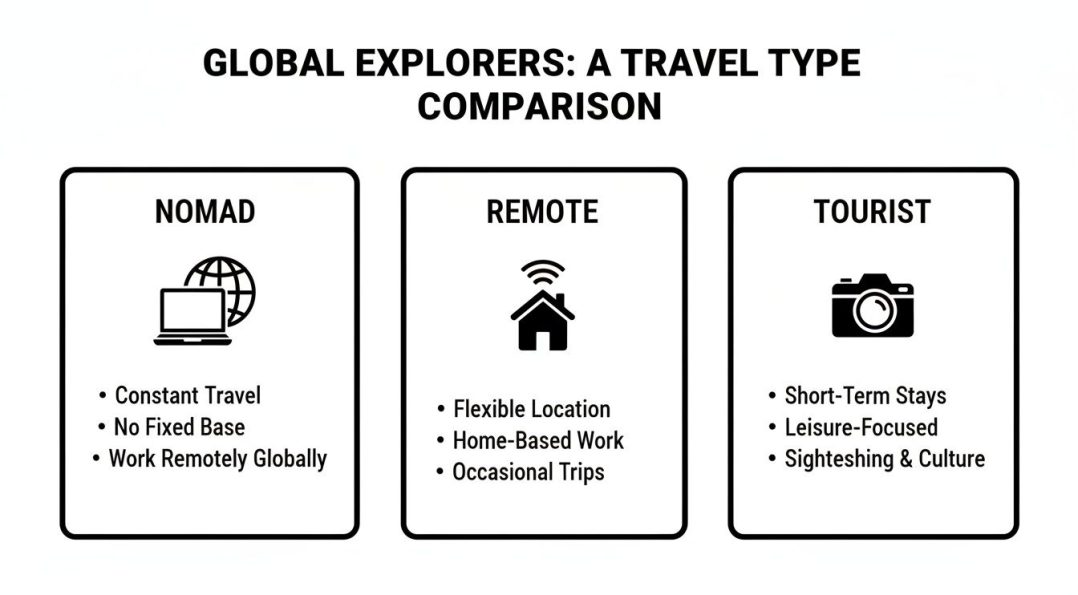
Image comparing global explorer types: Nomad, Remote, and Tourist, with their characteristics.
The image makes it clear: while the tourist focuses on leisure and the remote worker focuses on home stability, the digital nomad has found a middle point between both worlds. Understanding this difference is the first step to knowing whether this lifestyle is for you.
The Reality of a Location-Independent Life

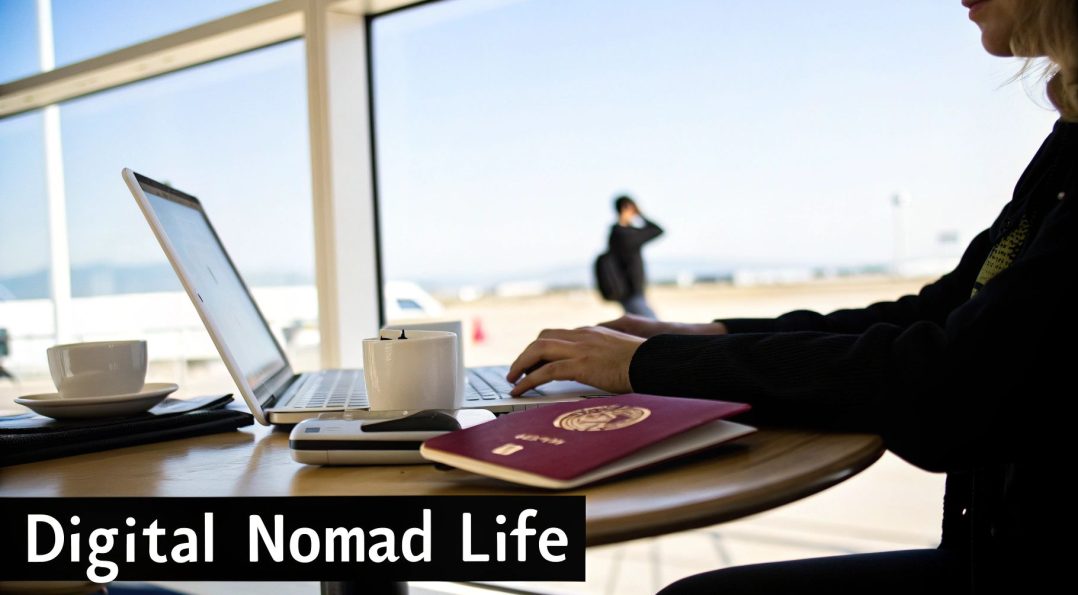
A person working on a laptop next to a passport, coffee cups, and an airfield view—symbolizing digital nomad life.
When you hear the term digital nomad, you probably imagine someone working from a hammock, laptop balanced, with the ocean breeze as their office soundtrack. And while moments like that do happen, day-to-day life is a complex mix of incredible freedom and major challenges (often left unspoken). It’s a lifestyle that demands as much discipline as it offers adventure.
To truly understand what it means to live this way, you have to look beyond the picture-perfect social media feeds. The appeal is powerful, no doubt. But the hurdles are just as real. Having a balanced view is key for anyone considering making the jump.
The Hard-to-Beat Advantages of Nomadic Life
One of the biggest benefits is deep cultural immersion. A tourist might skim the surface of a place for a week, but a digital nomad often stays for months. That extra time lets you go beyond landmarks, build real relationships with locals, pick up some of the language, and understand the rhythm of a new culture.
This kind of immersion almost guarantees personal growth. Figuring out unfamiliar systems—from public transport to grocery shopping in a language you barely speak—builds strong problem-solving skills and self-reliance. You’re constantly pushed out of your comfort zone, which develops an adaptability you simply can’t gain otherwise.
And, of course, there’s the financial side. If you strategically choose places with a lower cost of living than your home country, you can dramatically improve your quality of life. An income that barely covers the basics in a major city in the U.S. or Europe could afford you a much more comfortable lifestyle—better housing and more meals out—in places like Southeast Asia or parts of Latin America.
The real value of the nomadic lifestyle isn’t just seeing the world—it’s how the world changes you. It’s an active process of learning, adapting, and growing that transforms your personal and professional perspective.
The Less Glamorous Challenges
But all that freedom comes with its own set of problems. Loneliness is a huge and widely reported challenge. You’re always in new places, which means leaving behind your established support system of friends and family. And while you meet lots of people, forming deep, long-lasting connections can be difficult when you—or they—are always on the move.
Administrative and legal headaches are another major issue. Managing visa requirements is a constant task that requires meticulous planning. Overstaying a visa—even by a single day—can have serious consequences. On top of that, handling taxes across different countries is complicated and often requires professional help to stay compliant.
Finally, the lack of a “traditional” work structure demands immense self-discipline. There’s no boss looking over your shoulder and no fixed 9-to-5 schedule keeping you on track. That beautiful beach can easily become your biggest distraction.
-
Work-life separation: without the physical boundary of an office, it’s dangerously easy for work to spill into every hour of the day—fast-tracking burnout.
-
Building a routine: creating a productive routine while constantly adapting to new time zones and environments is a juggling act.
-
Staying focused: you are 100% responsible for your productivity, which means resisting the temptation to treat every day like a holiday.
At the end of the day, the reality of a location-independent life isn’t a permanent vacation. It’s a deliberate redesign of what work and life look like—and it offers incredible opportunities for those ready for its unique demands.
Building Your Mobile Office: The Essentials
A digital nomad is only as good as the tools they carry. Your mobile office is your lifeline—the bridge between your responsibilities and the freedom to explore the world. Putting together a powerful, lightweight, and reliable kit isn’t just about comfort; it’s the foundation for staying productive anywhere. A solid setup ensures you can deliver high-quality work, whether you’re in a busy city café or a quiet corner in the jungle.
And the cornerstone that holds everything together is a rock-solid internet connection. Without it, everything stops. That’s why certain destinations have become magnets for remote workers: they offer not only stunning landscapes, but also strong digital infrastructure.
Internet You Can Rely On
Destinations that truly understand digital nomads are investing heavily in connectivity. Tulum, for example, has addressed the issue in a very particular way within Mexico’s nomad scene. While fiber-optic internet has expanded in urban areas, coastal zones have adopted satellite solutions.
Places like Calea Tulum stand out for offering Starlink connections reaching 150 Mbps. This is crucial, especially when 48% of nomads move every 1 to 3 weeks and can’t afford to lose time to a weak signal. In Quintana Roo, fiber already covers over 70% of urban areas, but along the coast, Starlink helps ensure a consistent connection under the palm trees.
This technological advantage has attracted both freelancers (41% of nomads) and remote employees (34%), drawn by the perfect combination of speed, scenery, and cost of living. Local numbers speak for themselves: Tulum welcomed over 50,000 digital nomads in a single year—an increase of 150% compared to two years earlier. Learn more about the nomad boom and its impact on destinations like this.
Essential Hardware in Your Backpack
Once internet is sorted, the next step is your physical gear. The key is finding the right balance between power and portability.
-
A high-performance laptop: the heart of your operation. Choose a reliable model with strong battery life and enough power to run your tools smoothly.
-
A portable second monitor: a major productivity upgrade. A lightweight external screen doubles your workspace, making multitasking far easier without adding much weight.
-
Noise-canceling headphones: essential for focusing in airports, cafés, or coworking spaces. They create your own quiet bubble so you can work at your best.
-
A universal travel adapter and power bank: practical must-haves. A good adapter keeps you plugged in anywhere, and a powerful battery keeps devices running during long travel days or unexpected outages.
Think carefully about what you pack. Every gram counts, and every item should earn its place by serving a critical function.
Key Software to Stay Secure and Synced
Finally, your digital toolkit. The software that protects your data and keeps you connected is just as vital as your hardware.
-
VPN (Virtual Private Network): non-negotiable. It encrypts your connection and protects sensitive information when using public Wi-Fi in cafés, hotels, or airports.
-
Project management tools: Asana, Trello, or Jira help you stay organized, track deadlines, collaborate across time zones, and keep clients updated.
-
Cloud storage: Google Drive, Dropbox, or OneDrive are your digital safety net—backups and access from any device, anywhere.
Visas and Legal Requirements: What You Can’t Ignore
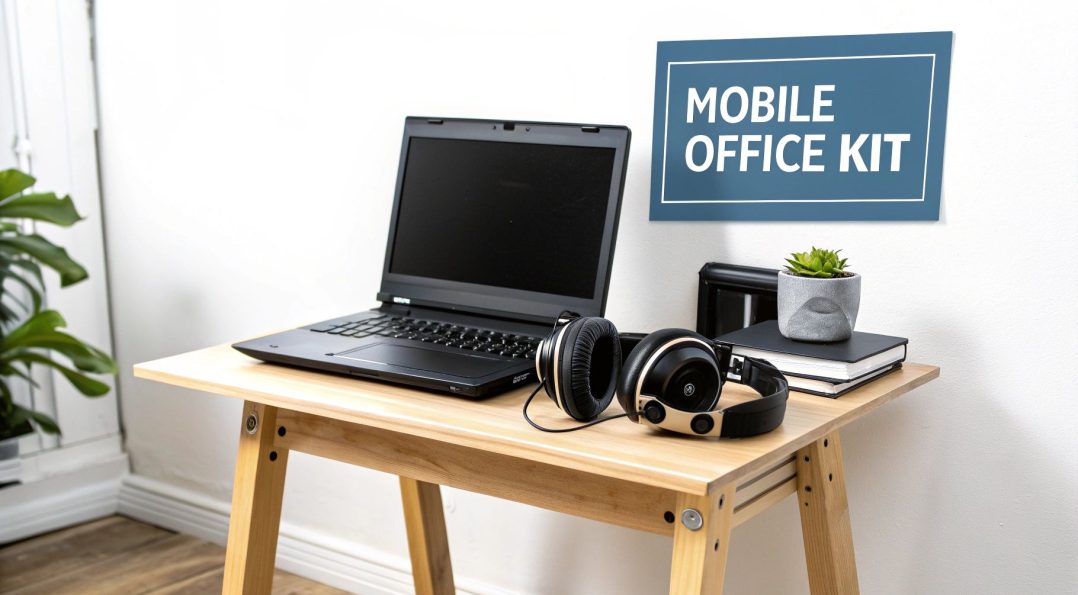
A black laptop, headphones, a plant, and books on a wooden desk next to a “Mobile Office Kit” sign.
Let’s talk about the one thing that can stop a nomadic journey faster than terrible Wi-Fi: paperwork. Understanding visas isn’t just another task—it’s the foundation of a sustainable digital nomad life. Arriving on a tourist visa and “hoping for the best” can put you in legal trouble, risking fines or even deportation.
The good news: as remote work has exploded, many governments are adapting. Today there’s a wide range of options—from short stays to visas designed specifically for remote workers. Understanding them is your first step toward a stress-free adventure.
Common Visa Options for Nomads
At first, the visa world can feel overwhelming. But it really comes down to a few main categories. The right choice depends on how you want to travel: hopping countries every few months or settling in to truly get to know a place.
-
Tourist visas: usually easy to obtain and allow stays of 30 to 90 days. Many nomads use them to “test the waters,” but be aware: working (even remotely) is often technically against the rules.
-
Digital nomad visas: the game-changers. More than 50 countries now offer official remote-work visas, allowing you to live and work legally for a year or more. Typically you’ll need proof of foreign income and health insurance.
-
Temporary residency: some countries, like Mexico, have long-term permits that work extremely well for nomads. They aren’t specifically “remote work” visas, but they allow you to stay one to four years if you can prove financial solvency.
A Closer Look at Mexico’s Temporary Residency
Mexico has been a favorite for years, and its Temporary Residency is one reason why. It’s popular because it offers stability without needing a traditional work permit—as long as your income comes from outside Mexico.
The process usually starts at a Mexican consulate in your home country. You’ll need documents proving steady monthly income or substantial savings. For example, for a permit of up to four years, the required monthly income is often around €1,742. This relatively straightforward path has turned the region into a hotspot for remote professionals.
The remote-work boom has driven a 131% increase in Americans identifying as nomads since the pandemic, and a large share choose Mexico. In Quintana Roo, long-term stays have grown by 200% since 2021, drawing professionals to hubs like Calea Tulum where this residency can be used as a stable, productive base.
The Critical Topic: Taxes
Beyond visas, there’s another legal reality no nomad can ignore: taxes. Where you owe taxes depends on your citizenship, where you live, and how long you spend in each country. A common rule is that if you spend more than 183 days a year in a country, you may be considered a tax resident there.
Navigating international taxes is complex. Rules vary widely, and mistakes can be expensive. The best recommendation is to talk to a tax professional who specializes in expats or nomads. They’ll help you understand obligations and stay compliant, avoiding legal issues.
How to Choose Your First Destination as a Nomad
Choosing your first digital nomad destination is far more strategic than spinning a globe and pointing. It can define your entire initial experience. Choose well and you’ll have an ideal launchpad with the support and infrastructure you need to stay productive and adapt to the lifestyle. Choose poorly and you may face frustration, logistical nightmares, and an early end to your adventure.
Think of it like planting a seed: you need fertile ground and the right conditions for growth. For a digital nomad, that means a place that balances work needs with quality of life—an environment where both your professional and personal life can thrive.
Key Criteria for a Strong Nomad Hub
Before you fall in love with postcard photos, evaluate a destination using practical, non-negotiable factors:
-
Reliable internet: your lifeline. Check nomad communities for real speed tests and neighborhood-specific reviews.
-
Cost of living: determines how long you can sustain this lifestyle. Tools like Nomad List can help estimate monthly costs.
-
Community and networking: loneliness can hit hard. A place with an established nomad community makes it easier to build connections and support.
-
Quality of life: safety, climate, culture, nature, healthcare, and overall vibe. What environment helps you feel balanced and inspired?
Why Tulum Can Be a Great First Stop
Tulum shows how these criteria can come together to create a compelling nomad destination. It has evolved from a quiet beach town into a hub that caters to modern remote workers, blending natural beauty with strong digital infrastructure.
Since the pandemic, Mexico has become a magnet for remote workers, and Tulum is at the center of that movement. Areas like Aldea Zama have grown into hubs with a clear work-life balance. You can find high-speed internet (like Starlink at 150 Mbps) for smooth video calls and still be 10 minutes by bike from beaches and Mayan ruins. It’s no surprise Mexico ranks highly for expats, in part because its cost of living often falls between $1,200 and $2,500 USD per month (depending on lifestyle).
Choosing your first destination is about minimizing friction: you want to spend your energy on your work and enjoying your surroundings—not constantly solving basic problems like Wi-Fi or housing.
Find Accommodation Designed for Nomad Life
Your accommodation matters just as much as the destination. For longer stays, you need a space that works as both a comfortable home and a productive office. That’s where nomad-focused concepts really stand out.
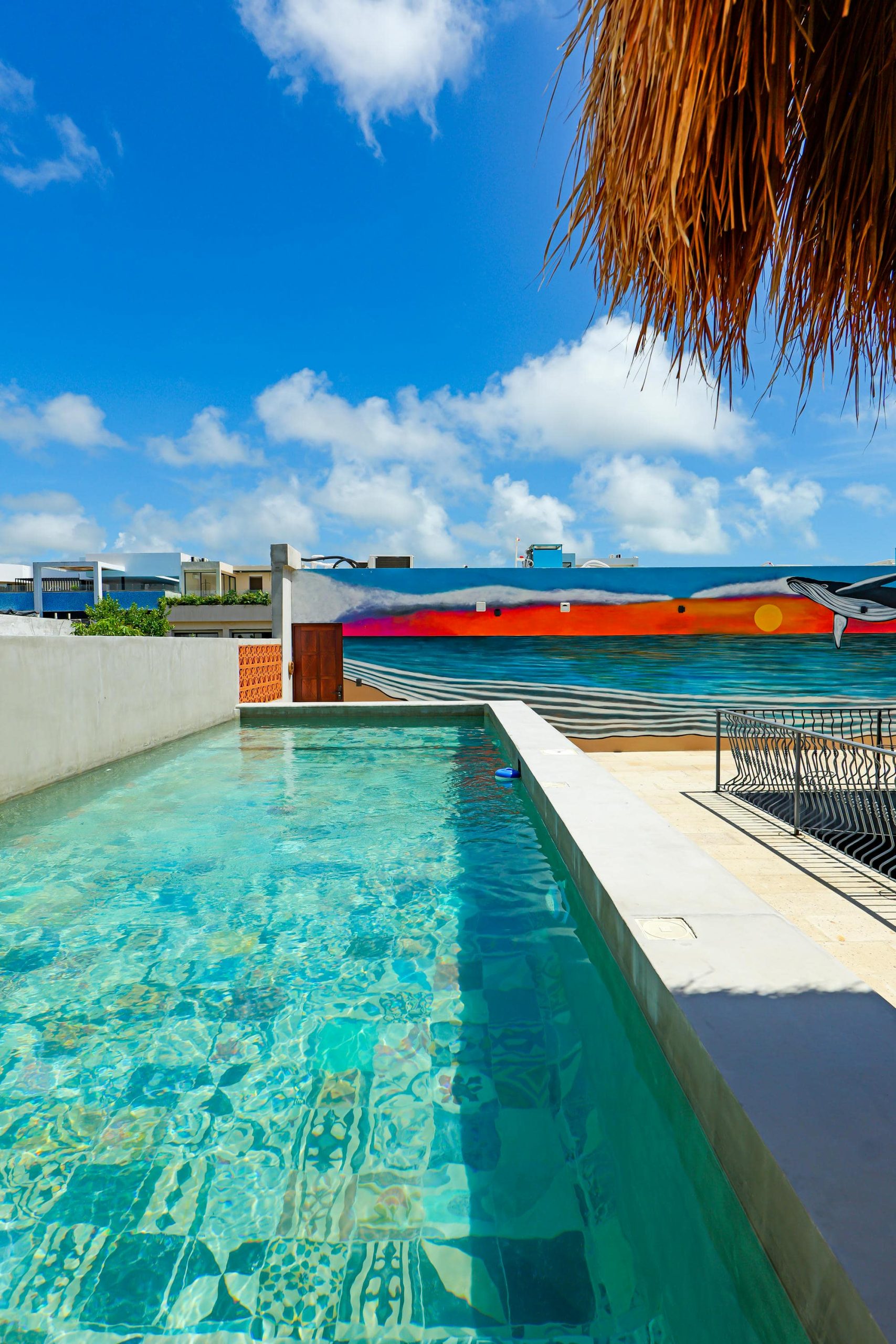
For example, a place like Calea Tulum is built with digital nomads in mind. It goes beyond “just a room” and offers an ecosystem for remote work and wellbeing.
Here’s what makes this kind of accommodation effective:
-
Guaranteed high-speed internet: with a dedicated connection, you reduce the risk of dropped calls and slow uploads.
-
Fully equipped spaces: kitchens or kitchenettes help lower costs and support healthier routines.
-
Built-in community: on-site classes and shared areas make it easier to meet like-minded people and reduce isolation.
When you choose a destination and accommodation that understand your needs, you start strong: a base that powers your work and enriches your life.
Common Questions About Digital Nomad Life
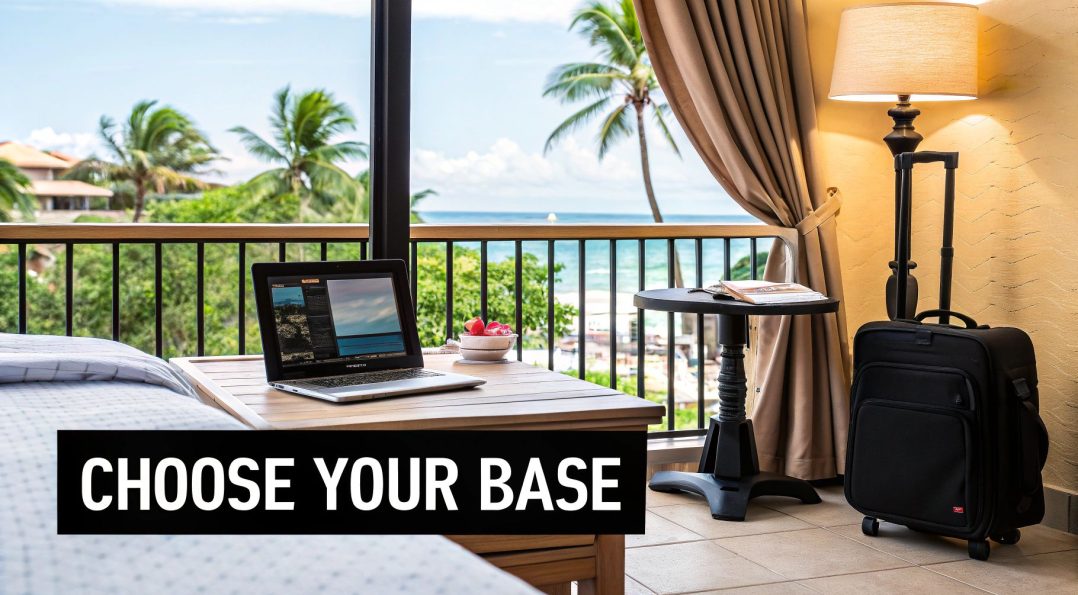
A tropical hotel balcony with a laptop on a table, overlooking the beach and the ocean.
Even after understanding the lifestyle, the tech, and the paperwork, it’s normal to still have questions. Making the leap to a location-independent life is a big decision. Questions are part of the process.
How Much Money Do I Need to Become a Digital Nomad?
There’s no magic number. It depends on where you’re going and how you like to live. A useful rule: have three to six months of living expenses saved before booking your flight. That’s your safety net.
In a place like Tulum, a monthly budget typically falls between $1,200 and $2,500 USD, covering housing, food, transportation, and some leisure (depending on your lifestyle).
Also remember: many long-stay options (like Mexico’s Temporary Residency) require proof of steady monthly income. Tools like Nomad List can help you build a realistic city-by-city budget.
What Are the Best Jobs for a Digital Nomad?
If you can do your job 100% online, you’re in. The idea is that your work isn’t tied to a physical office.
The most common fields include:
-
Software development & IT: programming, web development, cybersecurity.
-
Digital marketing: SEO, social media, content marketing, ads.
-
Creative work: graphic design, video editing, writing.
-
Online education: teaching languages or skills online.
-
Support roles: virtual assistants, customer support, project management.
Many people start freelancing on platforms like Upwork or Fiverr to build clients. Others look for remote-first companies. The key is having a skill that creates value regardless of location.
The real question isn’t just “finding a remote job”—it’s building a skill so valuable that you’re hired for results, not your address.
How Do Digital Nomads Handle Healthcare and Insurance?
This is critical. Your home-country insurance almost never covers long-term, multi-country travel. Ignoring this can get extremely expensive.
The most common solution is international health insurance, designed for people who travel or live abroad long-term. Companies like SafetyWing and World Nomads are popular because their policies fit nomad life—covering emergencies, hospitalization, and sometimes trip interruptions. Always read the fine print: coverage, exclusions, and deductibles.
Can You Be a Digital Nomad with Family or Pets?
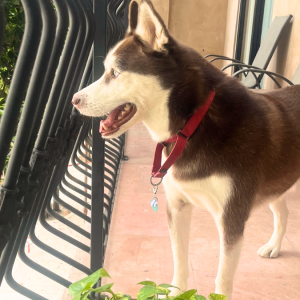
Yes—but it changes everything. It means more planning, more logistics, and a slower pace. More and more nomads travel with partners, kids, and pets, but they usually focus on building a home base for longer periods instead of moving every few weeks.
For families, that often means:
-
Slower travel: staying 3–6 months (or more) to create routine.
-
Family-friendly destinations: safety, schools or alternative education communities, and healthcare access.
-
Suitable accommodation: apartments or suites with kitchens, separate bedrooms, and pet-friendly policies.
Traveling with loved ones requires extra preparation (dependent visas, pet entry rules), but it’s becoming increasingly common—and it can be an incredible way to explore the world together.
Calea Tulum
At Calea Tulum, we offer a unique space where you can work, meet people, and enjoy the experience all at once. Book your stay at Calea Tulum here Calea Tulum.